When Theology Outpaces Intimacy

Five-week seriesWhen Theology Outpaces Intimacy · Five-week series
Preaching & Teaching Guide
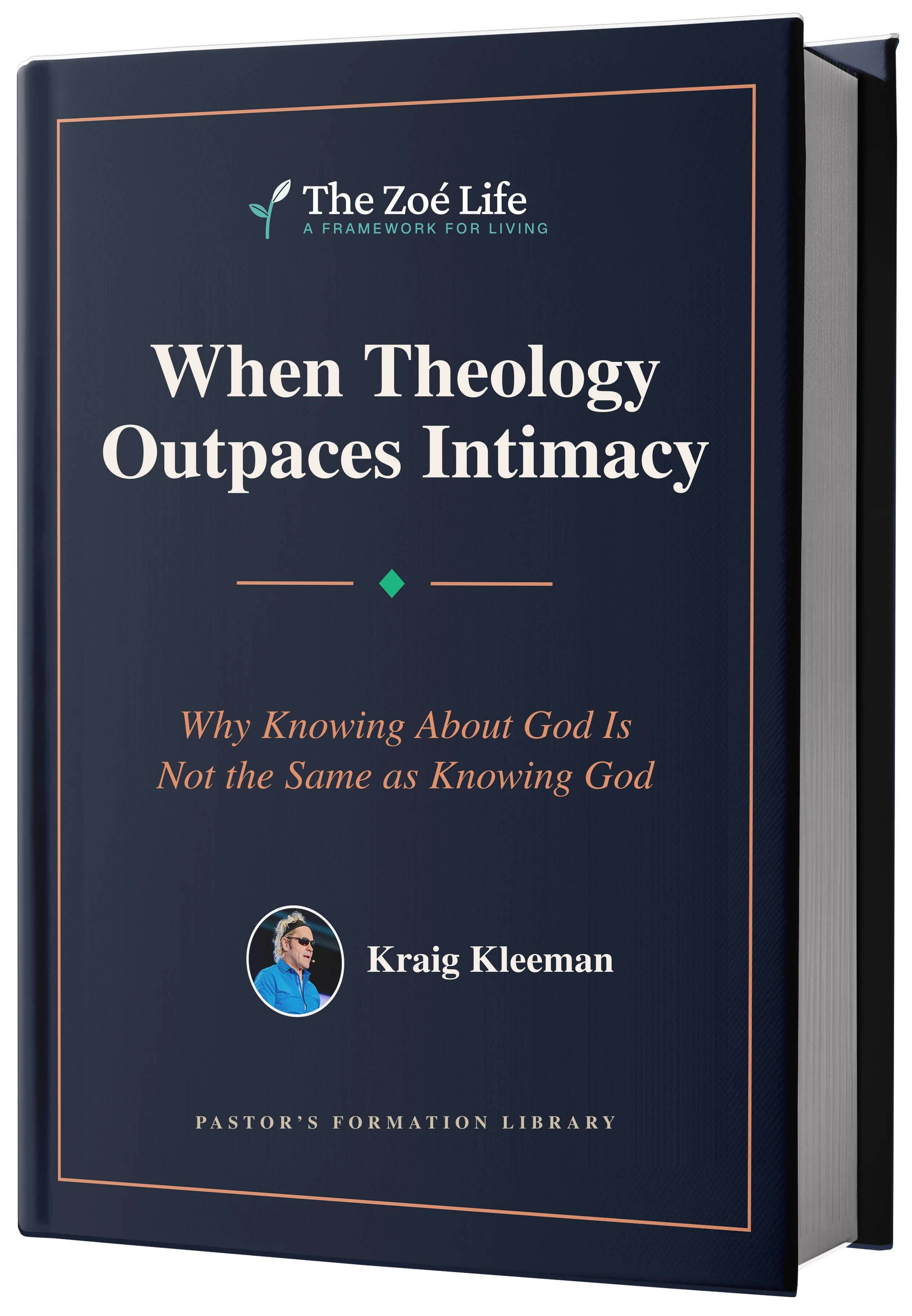
A five-week series for helping your church move from knowing about God to knowing Him.
Includes slides with speaker notes, this guide as a PDF and 4 team handouts.
Start here
How are you using this book?
- Five-week seriesOne Sunday per week, from knowing about God to friendship with Him.
- One messageA single sermon from the road to Emmaus that carries the whole arc.
- Class or small groupFive sessions of 60–75 minutes, with discussion built in.
Your first three steps
Download the Preaching & Teaching Kit
Slides, this guide and the handouts in one ZIP. Download it above ↑Read Week 1
and the book sections it lists. Go to Week 1Send your team the handouts
Each one says when to use it. See the handouts
The series
Series at a glance
- Week 1: About Him, or Him?John 5:39–40 · Matthew 15:8
- Week 2: When Truth Stops at the MindJames 1:22 · 1 Corinthians 8:1
- Week 3: Informed but Not FormedHebrews 5:12–14 · Galatians 5:22–23
- Week 4: Truth and Relationship TogetherPhilippians 3:10 · Mark 3:14
- Week 5: A Return to FriendshipJohn 15:15 · Psalm 95:6–7
Five Sundays, from knowing about God to walking with Him as a friend. Each shows the week's text and response. Select a week to jump to it.
Before the series
Planning checklist
Four weeks out
- Read the book through once, or at least the Introduction, Chapters 1, 5, 9 and the Conclusion.
- Meet with staff or group leaders using the Team Discussion Guide.
- Work through Six Practices for Leaders with your staff or elders.
Two weeks out
- Print Two Ways of Knowing for Weeks 1 and 5, and Yet Still Struggle for Week 2.
- Ask two or three people whether they would share how a truth they knew became a friendship with God.
- Send small-group leaders the five weeks of questions.
The week of each Sunday
- Read that week's “Read before you preach” chapters.
- Choose one illustration from your own church for each prompt you use.
- Prepare a slide with the big idea and the featured line.
Before Week 3
- Prepare cards and the fruit of the Spirit slide.
- Thank the people who teach in your church before you preach on knowledge and maturity.
Chapters 1–2
Week 1: About Him, or Him?
John 5:39–40 · Matthew 15:8
This week at a glance
- Big idea
- It is possible to know a great deal about God and still not know Him. Jesus said so to the most careful Bible students of His day, and He invites us past information into relationship.
- Prepare
- Copies of Two Ways of Knowing for everyone, and one person ready to share how they moved from knowing about God to knowing Him.
Show full outline for Week 1Hide full outline
Preach it
On the text
- John 5:39–40: “You search the Scriptures because you think that in them you have eternal life; and it is they that bear witness about me, yet you refuse to come to me that you may have life.” Jesus does not fault them for studying. He faults them for stopping short of Him.
- Matthew 15:8 quotes Isaiah 29:13: “This people honors me with their lips, but their heart is far from me.” The words were right. The distance was the problem.
- The Pharisees were not careless with Scripture. They were among the most devoted students of it in Israel, which is why Jesus' words to them land on careful believers today.
Read before you preach
- Knowing About God vs. Knowing GodChapter 1
- The Pharisee ProblemChapter 2
The message
Ask the room to think of a famous person they know a lot about: birthday, hometown, favorite food. Then ask how many of them have ever had that person over for dinner.
Two kinds of knowing. · Ch 1
They searched the Scriptures and missed Him. · John 5:39–40 · Ch 2
Lips near, hearts far. · Matt 15:8 · Ch 2
Come to Him. · John 5:40 · Ch 1
Hand out Two Ways of Knowing. Give people two quiet minutes to mark where they honestly are on each row, then pray John 5:40 back to God: “I want to come to You, not only learn about You.”
Where Jesus is in this text
Jesus defines eternal life this way: “that they know you, the only true God, and Jesus Christ whom you have sent” (John 17:3). The goal of the Scriptures is not a subject mastered but a Person known.
Lines from the book
Information and relationship are not the same thing.
It is possible to know the Scriptures and still struggle to know God.
Illustration prompts from your own church
- A season when you knew a lot about God but felt far from Him.
- Someone in your church whose friendship with God is obvious, whatever their level of training.
- The moment a truth you had known for years finally became personal.
Lead the response
On Sunday
Where am I on each row?
Give everyone Two Ways of Knowing. Invite each person to mark where they are between the two columns on every row, then circle the one row where they most want to grow.
Take it home · For households
Ask each person at dinner: “What is one thing you know about God, and one way you have actually experienced Him?”
Small-group questions
- How would you describe the difference between knowing about someone and knowing them?
- Which row on the handout was hardest to mark honestly?
- Why do you think the most careful Bible students of Jesus' day missed Him?
Bridge · Next week: what happens when truth stops at the mind and never reaches the life.
Chapters 3–4
Week 2: When Truth Stops at the Mind
James 1:22 · 1 Corinthians 8:1
This week at a glance
- Big idea
- Learning happens in the mind, but growth happens when truth reshapes a life. When information outpaces formation, God quietly becomes a subject to study instead of a Person to know.
- Prepare
- Copies of Yet Still Struggle for everyone.
Show full outline for Week 2Hide full outline
Preach it
On the text
- James 1:22: “But be doers of the word, and not hearers only, deceiving yourselves.” James says the person who only hears is not merely incomplete. They are self-deceived.
- James 1:23–24 compares the hearer to someone who “looks intently at his natural face in a mirror” and then “goes away and at once forgets what he was like.” The look was real. Nothing changed.
- 1 Corinthians 8:1: “This ‘knowledge’ puffs up, but love builds up.” Paul is not against knowledge. He is warning about knowledge that inflates the knower instead of building up the people around them.
Read before you preach
- When Information Outpaces FormationChapter 3
- The Cost of Theology Without IntimacyChapter 4
The message
Hold up a mirror. Ask the room what the point of a mirror is if you look in it, see something on your face, and walk away without doing anything about it.
Hearing is not the same as doing. · James 1:22 · Ch 3
The mirror we walk away from. · James 1:23–24 · Ch 3
Knowledge puffs up; love builds up. · 1 Cor 8:1 · Ch 4
When God becomes a subject. · Ch 4
Hand out Yet Still Struggle. Invite people to circle the struggles that are honestly theirs, then sit in silence with the book's reflection questions for two minutes.
Where Jesus is in this text
“The Word became flesh and dwelt among us” (John 1:14). God's truth did not stay an idea. In Jesus it took on a life, and He calls the truth in us to do the same.
Lines from the book
Learning occurs when information enters the mind. Growth occurs when truth reshapes a life.
God becomes a subject of study rather than a person to know.
Illustration prompts from your own church
- A time you knew the right answer and still did the wrong thing.
- Someone whose knowledge made them gentler, not harder, to be around.
- A truth you had studied for years that only changed you when you finally obeyed it.
Lead the response
On Sunday
From hearing to doing
Hand out Yet Still Struggle. Invite each person to circle one struggle on the right side and to write one step of obedience for this week.
Take it home · For households
Ask each person: “What is one thing you already know God is asking you to do, that you have not done yet?”
Small-group questions
- Where do you most often hear the word without doing it?
- How can you tell when knowledge is puffing you up rather than building others up?
- When has God felt more like a subject you study than a Person you know?
Bridge · Next week: why some believers who know the most stay spiritually immature, and how churches can accidentally produce them.
Chapters 5–6
Week 3: Informed but Not Formed
Hebrews 5:12–14 · Galatians 5:22–23
This week at a glance
- Big idea
- We tend to measure maturity by what someone knows. Scripture measures it by who they are becoming. A church can grow informed people without meaning to, unless it aims at formation.
- Prepare
- Small cards for everyone, and a slide of the fruit of the Spirit from Galatians 5:22–23.
Show full outline for Week 3Hide full outline
Preach it
On the text
- Hebrews 5:12: “For though by this time you ought to be teachers, you need someone to teach you again the basic principles of the oracles of God.” These were not new believers. Time alone had not matured them.
- Hebrews 5:14 says solid food is “for the mature, for those who have their powers of discernment trained by constant practice.” Maturity here is a trained habit of life, not a store of facts.
- Galatians 5:22–23 lists the fruit of the Spirit: “love, joy, peace, patience, kindness, goodness, faithfulness, gentleness, self-control.” None of the nine is a piece of information.
Read before you preach
The message
Ask the room how they would measure whether someone is a mature Christian. Write the answers on a slide, then put the fruit of the Spirit next to them.
You ought to be teachers by now. · Heb 5:12 · Ch 5
Maturity is trained by practice. · Heb 5:14 · Ch 5
The fruit Scripture measures. · Gal 5:22–23 · Ch 5
How churches drift toward information. · Ch 6
Show the fruit of the Spirit slide. Give each person a card and invite them to write the one fruit they most want God to grow in them, and one place this week where it will be tested.
Where Jesus is in this text
Paul's goal was “that we may present everyone mature in Christ” (Colossians 1:28). Maturity is not a level of knowledge we reach. It is Christ formed in us.
Lines from the book
We tend to evaluate maturity by what a person knows. Scripture often evaluates maturity by who a person is becoming.
The result is a growing number of believers who are informed but not deeply formed.
Illustration prompts from your own church
- Someone with little training whose life shows deep maturity.
- A time you were tempted to judge someone's maturity by how much they knew.
- What it looked like in your church when a person was formed, not just informed.
Lead the response
On Sunday
The fruit God is growing
Give each person a card. Invite them to write the one fruit of the Spirit they most want God to grow in them and one place it will be tested this week, then pray together for that fruit.
Take it home · For households
Read Galatians 5:22–23 together. Ask: “Which of these have you seen grow in each other this year?”
Small-group questions
- How has our culture taught you to measure spiritual maturity?
- Which fruit of the Spirit is most visible in your life, and which least?
- What would it look like for our church to aim at formation, not just information?
Pastoral note: This week can sound like a criticism of study or of those who teach. Say clearly that the answer is not less theology. Honor the people who teach in your church, and keep the focus on what knowledge is for.
Bridge · Next week: the biblical pattern where truth and relationship belong together, and how Jesus formed His disciples.
Chapters 7–8
Week 4: Truth and Relationship Together
Philippians 3:10 · Mark 3:14
This week at a glance
- Big idea
- The answer to theology without intimacy is not less theology. Scripture holds truth and relationship together, and Jesus formed His disciples by giving them both: His teaching and His presence.
- Prepare
- A slide of Mark 3:14, with “that they might be with him” highlighted.
Show full outline for Week 4Hide full outline
Preach it
On the text
- Paul was one of the best-trained theologians of his day, and he counted everything as loss “because of the surpassing worth of knowing Christ Jesus my Lord” (Philippians 3:8). Then he says, “that I may know him” (3:10).
- Mark 3:14: Jesus “appointed twelve … so that they might be with him and he might send them out to preach.” Being with Him came before being sent.
- Jesus taught His disciples constantly, and He lived with them. They heard the Sermon on the Mount, and they also ate with Him, walked with Him and watched Him pray.
Read before you preach
- The Biblical Pattern: Truth and RelationshipChapter 7
- How Jesus Formed DisciplesChapter 8
The message
Show the Mark 3:14 slide. Ask the room what Jesus could have taught the Twelve in a classroom, and what they could only learn by being with Him.
The surpassing worth of knowing Christ. · Phil 3:8–10 · Ch 7
Not less theology, but connected theology. · Ch 7
He called them to be with Him. · Mark 3:14 · Ch 8
Depth and intimacy, both. · Ch 8
Invite people into five minutes of being with Jesus: read Philippians 3:10 slowly twice, then sit in silence, and close by praying it together: “Lord, I want to know You.”
Where Jesus is in this text
On the road to Emmaus, Jesus opened the Scriptures and walked with two disciples, and they said, “Did not our hearts burn within us while he talked to us on the road?” (Luke 24:32). Truth and presence, together.
Lines from the book
The answer to theology without intimacy is not less theology. It is theology connected to relationship.
Jesus never chose between theological depth and intimacy. He cultivated both.
Illustration prompts from your own church
- A teacher or mentor whose life taught you as much as their words.
- A time study led you into worship rather than away from it.
- Someone in your church who holds deep theology and warm intimacy together.
Lead the response
On Sunday
Being with Him
Lead five minutes of silence after reading Philippians 3:10 twice. Invite each person to write one way they will spend unhurried time with Jesus this week, not to study Him but to be with Him.
Take it home · For households
Ask each person: “When this week did you feel close to God, not just informed about Him?”
Small-group questions
- Why do you think Mark puts “be with him” before “send them out”?
- Where has your theology led you into worship, and where has it kept you at a distance?
- What would it look like for you to cultivate both depth and intimacy this month?
Bridge · Next week: what it looks like to return to friendship with God, as a person and as a church.
Chapter 9 and Conclusion
Week 5: A Return to Friendship
John 15:15 · Psalm 95:6–7
This week at a glance
- Big idea
- Jesus calls us friends, not servants. Theology becomes transformative when it produces worship, and the church's calling is to teach people not only how to study God but how to walk with Him.
- Prepare
- Two Ways of Knowing again for everyone, and a closing time of worship.
Show full outline for Week 5Hide full outline
Preach it
On the text
- John 15:15: “No longer do I call you servants, for the servant does not know what his master is doing; but I have called you friends, for all that I have heard from my Father I have made known to you.” Friendship here includes knowledge, shared freely.
- Psalm 95:6–7: “Oh come, let us worship and bow down; let us kneel before the Lord, our Maker! For he is our God, and we are the people of his pasture.” The psalm moves from knowing who God is to bowing before Him.
- The Conclusion, “A Return to Friendship With God,” is short enough to read in full before you preach. Let it set the tone of the last Sunday.
Read before you preach
The message
Ask the room what makes a friendship different from an acquaintance. Then read John 15:15 and let the word “friends” sit for a moment.
No longer servants, but friends. · John 15:15 · Conclusion
Theology that ends in worship. · Ps 95:6–7 · Ch 9
Learning to walk with Him. · Ch 9
A church of friends of God. · Conclusion
Give out Two Ways of Knowing again and invite people to mark where they are now, five weeks later. Then move straight into worship with Psalm 95:6.
Where Jesus is in this text
“Greater love has no one than this, that someone lay down his life for his friends” (John 15:13). Jesus does not only call us friends. He laid down His life to make us His friends.
Lines from the book
Theology becomes transformative when it produces worship.
Many believers have been taught how to study God. Far fewer have been taught how to walk with Him.
Illustration prompts from your own church
- Someone whose friendship with God has shaped yours.
- A time your theology led you to your knees in worship.
- What walking with God has looked like for you on an ordinary Tuesday.
Lead the response
On Sunday
Friends of God
Hand out Two Ways of Knowing again. Invite each person to mark where they are now and to write one sentence to God as a friend, then close the series in worship.
Take it home · For households
Ask each person: “What is one way we could walk with God together as a family, not just learn about Him?”
Small-group questions
- What does it mean to you that Jesus calls you His friend?
- Where has your knowledge of God led you into worship during this series?
- Looking back over five weeks: what has changed in the way you walk with God?
Bridge · Close with the book's own line and let the church leave holding it: “Theology becomes transformative when it produces worship.”
One-message version
“Hearts Burning on the Road”
Luke 24:13–35
Big idea
Two disciples knew everything about Jesus and still did not recognize Him. When He opened the Scriptures and sat at their table, information became recognition, and their hearts burned.
They knew all the facts and were still downcast. · Luke 24:17–24 · Ch 1–2
He opened the Scriptures to them. · Luke 24:25–27 · Ch 3–4
“Stay with us.” · Luke 24:28–29 · Ch 5–6
Known in the breaking of the bread. · Luke 24:30–31 · Ch 7–8
Hearts burning, back on the road. · Luke 24:32–35 · Ch 9, Conclusion
Information and relationship are not the same thing.
Pick one illustration from your own church for movement 1 and one for movement 4; those two carry the message. Movement 4 is where knowledge turns into recognition, so give the response below before the final song.
Response
“Stay with us”
Read Luke 24:29 aloud, then give two minutes of silence. Invite each person to pray the disciples' words to Jesus in their own way: not “teach me more about You,” but “stay with me.”
Class version
Teaching this as a class
Use Weeks 1–5 as five sessions of 60–75 minutes. Ask the class to read the matching chapters before each session. Every session follows the same rhythm:
Open with a story
10 min · One person shares how something they knew about God became personal.
Read the text
10 min · Read the week's passage aloud, then once more slowly.
Teach
20 min · Work through the week's outline and lines from the book.
Discuss
20 min · Use the small-group questions. Let quieter people answer first.
Practice
10 min · Work through the week's handout, or close in unhurried prayer together.
Leadership sidebar · For staff and elders before the series
Building a Church That Knows God
This series will ask your people whether they know God or only know about Him. Before it starts, ask the same of your church's discipleship. Spend one meeting with staff or elders on Chapters 6 and 9 and the Six Practices sheet.
Theology without intimacy produces dryness. Intimacy without theology produces instability.
How we accidentally form
Which of our programs reward knowing more over becoming more? (Ch 6)
Teaching toward worship
Does our teaching end in information or in worship and response? (Ch 9)
Walking, not only studying
Who is teaching our people how to walk with God day to day? (Ch 9)
Handouts for your team
- Staff & leadersTeam Discussion GuidePDF: download Team Discussion Guide
Staff or group leaders: read the book together before the series starts.
- Staff & leadersSix Practices for LeadersPDF: download Six Practices for Leaders
Staff and elders: work through it before Week 1 and again after Week 5.
- PDF: download Two Ways of Knowing
- PDF: download Yet Still Struggle
Three months later
After the series
About three months after Week 5, gather your leaders again and ask:
- Where are our people walking with God, not only learning about Him?
- Which of the six practices have we actually begun, and which have we only talked about?
- How are we measuring maturity now: by what people know, or by who they are becoming?
About this guide
A guide, not a manuscript
Each week gives you a text, a big idea and an outline, then gets out of the way so you can do your own study and preach in your own voice. The best illustrations will come from the people in your church, not from this page, so the prompts point you there.
Lines marked Lines from the book are quoted word for word from When Theology Outpaces Intimacy, and the handouts carry the book's own charts, practices and reflection questions. Everything else, including the series title, Scripture choices, notes on the text, openings, outlines, prompts, take-homes and questions, was prepared for this guide. Chapters 6 and 9 also speak to church leaders, so their leadership angle appears in the leadership sidebar and the Six Practices team sheet.