Church Growth and the Metrics That Matter

Five-week seriesChurch Growth and the Metrics That Matter · Five-week series
Pastor Preaching & Teaching Guide
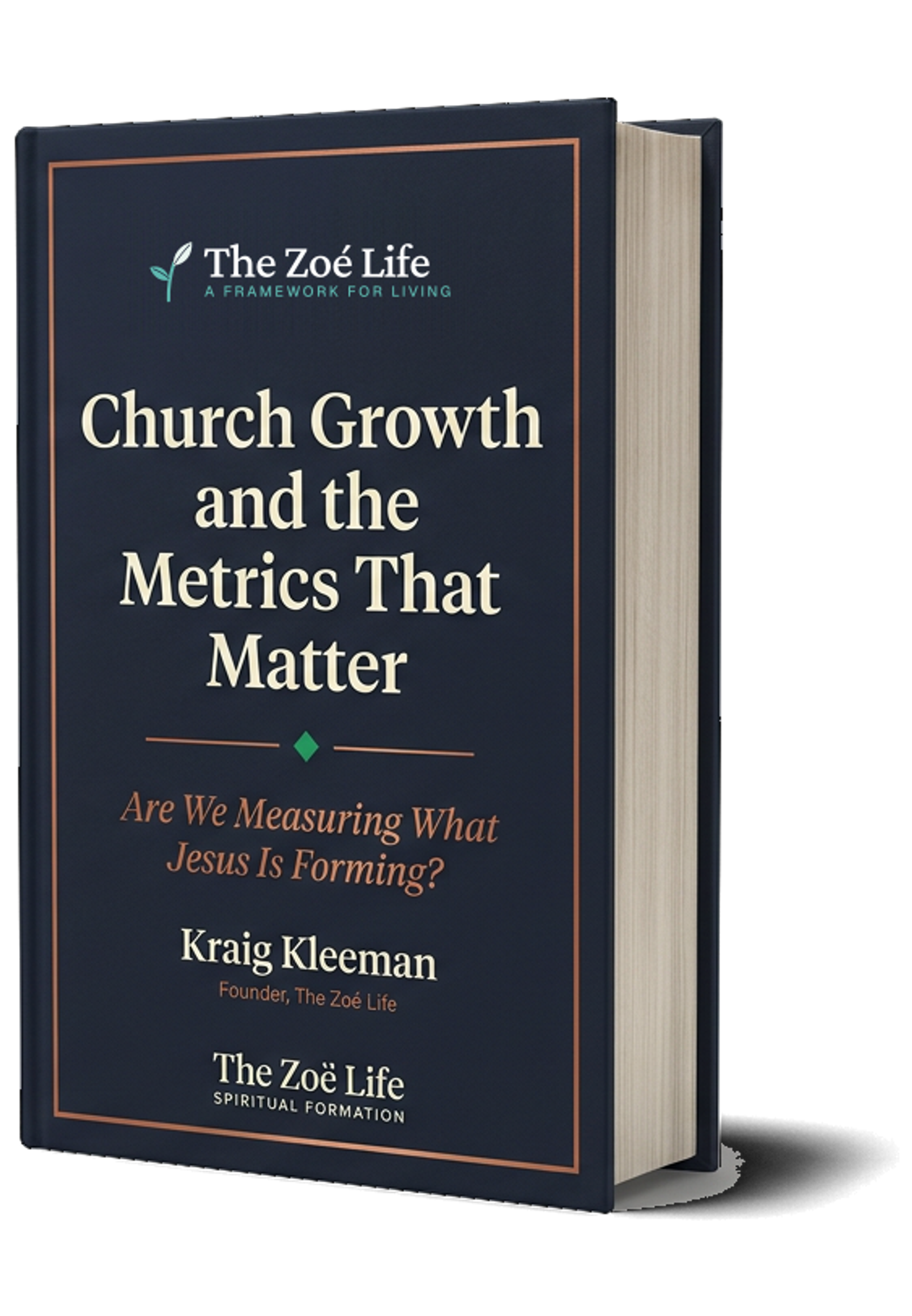
What Is Jesus Forming in Us? A five-week series on growing in Christ, not just in activity.
Includes 72 slides with speaker notes, this guide as a PDF and 3 team handouts.
Start here
How are you using this book?
- Five-week seriesOne Sunday per week, following the book's arc.
- One messageA single sermon from Galatians 4:19 and Colossians 1:28 that carries the whole arc.
- Class or small groupFive or six sessions of 60–75 minutes, with discussion built in.
Your first three steps
Download the Preaching & Teaching Kit
Slides, this guide and the handouts in one ZIP. Download it above ↑Read Week 1
and the book sections it lists. Go to Week 1Send your team the handouts
Each one says when to use it. See the handouts
The series
Series at a glance
- Week 1: Until Christ Is Formed in YouGalatians 4:19 · Colossians 1:28–29
- Week 2: Busy Is Not the Same as GrowingRevelation 2:1–7
- Week 3: Direction, Not PerfectionPhilippians 3:12–14 · Galatians 5:22–23
- Week 4: The Questions Jesus AsksMark 8:27–29 · John 21:15–17
- Week 5: Fruit That RemainsJohn 15:1–8, 16 · 2 Corinthians 3:18
Five Sundays, from the question Paul cared about most to the fruit Jesus said would remain. Each shows the week's text and response. Select a week to jump to it.
Before the series
Planning checklist
Four weeks out
- Read the book through once, or at least Chapters 1, 3, 9, 11 and the Conclusion.
- Meet with staff or elders using the leadership sidebar, and look through the Formation Scorecard together.
- Invite two or three people to share a short, honest “direction, not arrival” story in Week 3.
Two weeks out
- Print the Week 1 cards: “Lord, form Christ in me in ________.”
- Buy envelopes for the Week 3 letters, and decide who will keep them safe for six months.
- Print the four-question cards for Week 4.
- Send small-group leaders the five weeks of questions.
The week of each Sunday
- Read that week's “Read before you preach” sections.
- Choose one illustration from your own church for each prompt you use.
- Prepare a slide with the big idea, the featured line and the diagram.
Before Week 5
- Remind people to bring their Week 1 card.
- Bring a cut flower and a potted plant for the opening.
- Put the date to return the Week 3 letters on the church calendar.
Chapters 1–3
Week 1: Until Christ Is Formed in You
Galatians 4:19 · Colossians 1:28–29
This week at a glance
- Big idea
- The goal of everything a church does is not a busier people but a people in whom Christ is being formed, and that is the question God keeps asking of us.
- Prepare
- Cards printed with one line: “Lord, form Christ in me in ________.”
Show full outline for Week 1Hide full outline
Preach it
On the text
- Paul uses the image of childbirth (“in the pains of childbirth”, Gal 4:19), and uses it of himself. Formation is costly, slow work, and a pastor feels it.
- “Formed” (morphoō) is the root of “morph”. Paul is not asking for better behavior on the surface but for Christ's shape to grow from within.
- In Colossians 1:28, “everyone” appears three times. Maturity is not for a spiritual elite; Paul aims at every person in the church.
Read before you preach
- Three Different QuestionsChapter 1
- What the Report Was Not Designed to Tell UsChapter 2
- Present Everyone Mature in ChristChapter 3
The message
Tell the book's opening story: a pastor is asked when God last spoke to him, and he opens his laptop to show a program. Ask the church how they would have answered.
Paul measured his ministry by one thing: Christ formed in his people. · Gal 4:19 · Ch 1, 3
We can know a great deal about what a church does and little about what is happening in its people. · Ch 1–2
- A person can become more active in churchwithout becoming more like Jesus.
- A person can gain more biblical informationwithout becoming more loving.
- A person can become more skilled in leadershipwithout becoming more humble.
- A person can become more influentialwithout becoming more mature.
Maturity in Christ is the goal, so Paul labors toward it with God's own energy. · Col 1:28–29 · Ch 3
The real question is not “How much are you doing?” but “What is Jesus forming in you?” · Ch 1, 3
Land on Paul's longing in Galatians 4:19. Invite the church to spend five weeks asking one question together, gently and without scorekeeping: what is Jesus forming in us?
Where Jesus is in this text
Formation is not self-improvement with Christian vocabulary. Christ himself is being formed in us, and he is also the one forming us: the image we are being shaped into and the Lord who does the shaping (Rom 8:29).
Lines from the book
And discipleship is ultimately about people being formed into the likeness of Christ.
A dashboard does not alert a pastor that people are becoming increasingly informed but less responsive.
The goal is not spiritual ranking. It is spiritual visibility.
Illustration prompts from your own church
- A season when your church was very busy, and what you now see God was or was not forming in people during it.
- A person in your church whose growth in Christ you have watched over years. Ask their permission before you tell it.
- A time when someone asked you a spiritual question and you answered with your schedule.
Lead the response
On Sunday
Form Christ in me
Hand out cards printed with one line: “Lord, form Christ in me in ________.” Invite each person to fill in one area of life, then keep the card in their Bible for the rest of the series.
Take it home · For households
Around the table this week, have each person finish the sentence: “One way I am different from a year ago is…”
Small-group questions
- If someone asked you when God last spoke to you clearly, what would you honestly say?
- Where are you more active than you were a few years ago, but not more like Jesus?
- What would it look like for Christ to be “formed” in your home or work?
Bridge · Next week: a church Jesus praised for its hard work, and then told it had lost something.
Chapters 4–7
Week 2: Busy Is Not the Same as Growing
Revelation 2:1–7
This week at a glance
- Big idea
- A church can be faithful, tireless and orthodox and still drift from the love that is meant to drive it all; Jesus calls such a church to remember, repent and return.
- Prepare
- Paper and pens so people can list their regular church commitments.
Show full outline for Week 2Hide full outline
Preach it
On the text
- Each of the seven letters begins with what Jesus knows (“I know your works”, v2). He is not unaware of the effort; he has counted it.
- Ephesus had been the base of Paul's longest ministry (Acts 19–20). This was a mature, well-taught church, not a young or careless one.
- The lampstand (v5) is the church's witness (Rev 1:20). The warning is serious: a church can keep its programs and lose its light.
Read before you preach
- What Gets Celebrated Gets RepeatedChapter 4
- Exposure Is Not TransformationChapter 5
- Correlation Is Not CausationChapter 6
- Month ThreeChapter 7
The message
Describe the faithful volunteer from Chapter 5: serves twice a month, gives, rarely misses Sunday. Then ask the uncomfortable question the book asks: is he becoming more like Jesus?
Jesus sees and praises the work: toil, endurance and discernment. · Rev 2:2–3 · Ch 4
- He serves twice a month.
- He gives consistently.
- He rarely misses Sunday.
- He has completed several classes.
- He knows the language of the church.
- He understands the rhythms.
Activity is not the same as formation. A busy church can still be losing its first love. · Rev 2:4 · Ch 5
What we count and celebrate can hide what is happening inside people. · Ch 4, 6
The way back is not less work but a return to love: remember, repent, return. · Rev 2:5 · Ch 7
Land on verse 5: “Remember therefore from where you have fallen.” Ask the church to remember a time their faith felt like love, not obligation, and to go back there this week.
Where Jesus is in this text
The one who walks among the lampstands (v1) is not a manager reviewing a report. He is the bridegroom who wants his people's love, and the promise to the one who conquers is the tree of life in God's paradise (v7).
Lines from the book
Fruit through a person is not always the same thing as fruit in a person.
That means someone can become increasingly skilled at church without becoming correspondingly mature in Christ.
But the beginning of discipleship is not the same as growth in discipleship.
Illustration prompts from your own church
- A ministry your church kept running long after anyone could say what it was forming in people.
- A season in your own life when you were faithful in activity but distant from Jesus. Tell it briefly and honestly.
- Someone whose quiet, ordinary growth never appeared on any report but was plain to everyone who knew them.
Lead the response
On Sunday
Return to first love
Invite people to write down their regular church commitments, then circle the one they do most from habit. This week, before that activity, spend ten minutes alone with Jesus and tell him why you began.
Take it home · For households
At dinner, have each person name one church activity they love and one they mostly do from habit. No fixing, just noticing.
Small-group questions
- What would Jesus praise in your life? What might he say he holds against you?
- Which of your spiritual activities have become routine rather than relationship?
- What does “do the works you did at first” look like for you?
Bridge · Next week: how to see growth honestly, without pretending we have arrived.
Chapters 8–10
Week 3: Direction, Not Perfection
Philippians 3:12–14 · Galatians 5:22–23
This week at a glance
- Big idea
- God is not asking whether we have arrived but whether we are moving toward Christ, and the fruit of the Spirit shows us which way we are heading.
- Prepare
- Envelopes for the letters, and someone to keep them safe for six months.
Show full outline for Week 3Hide full outline
Preach it
On the text
- Paul writes this after listing his impressive record (Phil 3:4–6) and calling it loss. The man with the strongest résumé in the church is the one who says he has not arrived.
- “Press on” and “strain forward” (vv12–14) are words of effort, but verse 12 grounds the effort in grace: “because Christ Jesus has made me his own.”
- “Fruit” (Gal 5:22) is singular. These are not nine separate achievements but one life grown by the Spirit, which is why growth in one tends to show in others.
Read before you preach
- The Formation ScorecardChapter 8
- Static Scores Miss MovementChapter 9
- Setbacks Do Not Erase GrowthChapter 9
- What This Could Look Like in PracticeChapter 10
The message
Ask how many people have ever felt they were failing at being a Christian. Then read Paul, near the end of his life, saying he has not yet arrived.
Even Paul said, “Not that I have already obtained this.” · Phil 3:12 · Ch 9
Formation is a direction, not a score. Setbacks do not erase growth. · Phil 3:13 · Ch 9
The Spirit's fruit is how we notice the direction: love, joy, peace, patience… · Gal 5:22–23 · Ch 8, 10
Where were you six months ago?
Where are you now?
What has changed?
What has remained stuck?
What has become easier?
Where does resistance remain?
What old pattern has weakened?
What new responsibility are you ready to carry?
Press on, because Christ has already made us his own. · Phil 3:12, 14 · Ch 9
Land on verse 14. Invite the church to stop asking “Am I there yet?” and start asking “Which way am I facing?”
Where Jesus is in this text
Philippians 3 begins with Christ's righteousness given to us (v9) before any pressing on. We move toward Christ because we already belong to him, and the Spirit who bears fruit in us is his Spirit.
Lines from the book
Formation is better understood as direction than arrival.
Sometimes growth is visible not in the absence of failure but in the way failure is handled.
One of the clearest signs of maturity is a growing capacity to help someone else mature.
Illustration prompts from your own church
- A setback in your church's story that, looking back, became part of its growth.
- Someone who has not “arrived” but is clearly moving toward Christ, and how you can tell.
- A fruit of the Spirit you have seen God grow slowly in you, perhaps without noticing until later.
Lead the response
On Sunday
A letter to six months from now
Hand out envelopes. Invite each person to write a short letter: where they are now, what they are asking Jesus to form, and what they hope will be different. Seal the envelopes, collect them, and return them in six months.
Take it home · For households
Each person names one fruit of the Spirit they have seen grow in someone else at the table this year. Say it to them directly.
Small-group questions
- Where were you six months ago, spiritually? Where are you now?
- Which fruit of the Spirit is growing in you? Which one is still hard?
- How do you usually handle failure, and how is God changing that?
Bridge · Next week: the questions Jesus asked people, and why they matter more than our answers.
Chapters 11, 13–14
Week 4: The Questions Jesus Asks
Mark 8:27–29 · John 21:15–17
This week at a glance
- Big idea
- Jesus forms his people by asking questions that go past what we know to who we love, and he welcomes honest, unfinished answers.
- Prepare
- Cards printed with the four questions from Chapter 1.
Show full outline for Week 4Hide full outline
Preach it
On the text
- Caesarea Philippi (Mark 8:27) was a center of pagan worship. Jesus asks his question in a place surrounded by other answers.
- The first question is safe (other people's opinions); the second is personal. Jesus will not let the disciples stay with information about him.
- Peter denied Jesus three times beside a charcoal fire (John 18:18); Jesus restores him three times beside another (John 21:9). Each question ends in a commission: “Feed my sheep.”
Read before you preach
- Vague Questions Produce Vague AnswersChapter 11
- Ask AgainChapter 11
- The Role of TestimonyChapter 13
- Formation Is Often Too Gradual to NoticeChapter 14
The message
Ask the church to recall the best question anyone ever asked them, one that changed something. Then read the two questions Jesus asks in Mark 8.
Jesus moves from “Who do people say I am?” to “Who do you say I am?” · Mark 8:27–29 · Ch 11
Better questions draw out better answers. Vague questions get vague answers. · Ch 11
After Peter's failure, Jesus asks one question three times: “Do you love me?” · John 21:15–17 · Ch 11
“I do not know.”
“I am still struggling.”
“I think God may be showing me something, but I am still testing it.”
“I obeyed in one area and resisted in another.”
“I have made progress, but I am not free yet.”
Honest, unfinished answers are welcome. Remember them, and ask again. · Ch 11, 14
Land on John 21:17: “Lord, you know everything; you know that I love you.” Invite the church to answer Jesus' question honestly this week, even if the answer is unfinished.
Where Jesus is in this text
The questions are not a test from a distant examiner. The risen Christ asks them over breakfast he has cooked himself (John 21:9–12), and his question to a failed disciple ends in a calling, not a verdict.
Lines from the book
Evidence is more useful than self-description.
If every testimony must end in triumph, people will hide unfinished stories.
We cannot recognize patterns of formation if we keep forgetting the moments that form them.
Illustration prompts from your own church
- A question someone asked you that God used to change your direction.
- A time your church celebrated finished stories and someone with an unfinished one felt unable to speak.
- Your own “Do you love me?” moment: when Jesus met you after failure and called you again.
Lead the response
On Sunday
Better questions
Give each person a card with four questions from Chapter 1: “What is God teaching you?” “Where are you being convicted?” “Whom have you forgiven?” “Where has fear lost some of its grip?” Invite them to answer one in writing this week and share it with one person.
Take it home · For households
Put one question on the table this week, such as “Where did you see God today?” and let everyone answer, including the adults.
Small-group questions
- Who do you say Jesus is, in your own words, this week?
- When Jesus asks, “Do you love me?” what is your honest answer right now?
- What is a question you need someone to ask you regularly?
Pastoral note: Some in the room carry unfinished stories: a marriage still hard, a habit not yet broken, a prayer not yet answered. Say clearly that an unfinished story is welcome here.
Bridge · Next week: the fruit that lasts, and how it grows.
Chapters 16–17, Conclusion
Week 5: Fruit That Remains
John 15:1–8, 16 · 2 Corinthians 3:18
This week at a glance
- Big idea
- Lasting fruit comes from abiding in Jesus, and as we behold him together, we are being transformed into his image from one degree of glory to another.
- Prepare
- A cut flower and a potted plant for the opening, and a reminder to bring the Week 1 cards.
Show full outline for Week 5Hide full outline
Preach it
On the text
- Jesus says “abide” (menō, to remain or stay) eleven times in John 15:1–11. The command is not to produce but to stay.
- Pruning (v2) happens to fruitful branches. Painful seasons are not always signs of failure; they can be the gardener's care.
- “From one degree of glory to another” (2 Cor 3:18) is a picture of gradual change, and the verb is passive: we are being transformed.
Read before you preach
- Abiding Before ProducingChapter 3
- The Scorecards Interpret One AnotherChapter 16
- Celebrate DirectionChapter 17
The message
Hold up a cut flower and a potted plant. Both look alive today. Ask which one will still be alive in a month, and why.
Jesus is the vine, the Father is the gardener, and we are the branches. · John 15:1–5 · Ch 3
Apart from him, we can do a great deal of activity, but nothing that lasts. · John 15:5 · Ch 16
Transformation happens by degrees, as we behold the Lord. · 2 Cor 3:18 · Conclusion
The first asks
How many? How much? How far? How often?
The second asks
What is changing? What is deepening? What is weakening? What is being obeyed? What is being healed? What is being formed?
He chose us to bear fruit that remains, so go. · John 15:16 · Ch 17
Land on John 15:16: “I chose you and appointed you that you should go and bear fruit and that your fruit should abide.” Send the church out as people being formed, not people who must perform.
Where Jesus is in this text
Jesus does not only teach about the vine; he is the vine. The fruit the Father looks for is Christ's own life in his people, and the glory we behold in 2 Corinthians 3 is “the glory of the Lord.”
Lines from the book
But over time, abiding should leave evidence.
A person may still struggle with fear but no longer allow fear to make every decision.
We do not need a system that ranks believers.
Illustration prompts from your own church
- Fruit from your church's history that has lasted long after the program that started it ended.
- A pruning season, in your church or your life, that later bore fruit.
- Someone in the church who now helps others grow, whom you once helped grow yourself.
Lead the response
On Sunday
Name the fruit
Invite people to turn to someone they know and answer the question from Chapter 1 about each other: “Where are you becoming more like Jesus?” Then close by praying John 15:16 over the church.
Take it home · For households
Open the Week 1 card together. Has anything changed? Thank God out loud for one small sign of growth.
Small-group questions
- What does abiding in Jesus look like on an ordinary Tuesday for you?
- What fruit in your life do you hope will still be there in ten years?
- Over these five weeks, what has Jesus been forming in you?
Bridge · Close with the book's final words: “Formed people. People who are becoming like Jesus.”
One-message version
“What Is Jesus Forming in Us?”
Galatians 4:19 · Colossians 1:28–29
Big idea
The question God asks of a church is not only how much it is doing, but whether Christ is being formed in its people.
Paul measured his ministry by Christ formed in his people. · Gal 4:19 · Week 1
Busy is not the same as growing. · Rev 2:2–5 · Week 2
God looks for direction, not perfection. · Phil 3:12–14 · Week 3
Jesus asks questions that reach the heart. · John 21:15–17 · Week 4
Abide, and bear fruit that remains. · John 15:5, 16; Col 1:28–29 · Week 5
A person can become more active in church without becoming more like Jesus.
Pick one illustration from your own church for movement 2 and one personal story for movement 4; those two carry the message. Keep movement 3 gentle so no one leaves feeling graded.
Response
Ask one question
Before people leave, invite them to ask one person this week the question from Chapter 1, “Where are you becoming more like Jesus?”, and to listen to the answer without fixing it.
Class version
Teaching this as a class
Use Weeks 1–5 as five sessions of 60–75 minutes. Ask the class to read the matching chapters before each session. Every session follows the same rhythm:
Open with a story
10 min · One person shares a way they are different from a year ago.
Read the text
10 min · Read the week's passage aloud, then once more slowly.
Teach
20 min · Work through the week's outline and lines from the book.
Discuss
20 min · Use the small-group questions. Let quieter people answer first.
Practice
10 min · Try the week's response, or plan how to do it at home.
Optional session 6 · Take-home
Give each person the Formation Scorecard as a private reflection, not a test. Invite them to write one piece of evidence for each sign, then share one with a trusted friend during the following week.
Leadership sidebar · For staff and elders before the series
Measuring What Jesus Is Forming
The book is written for leaders; this series is for the whole church. Before Week 1, spend one meeting with your staff or elders on Chapters 8, 12 and 15–17, where the book turns its questions into practice.
A dashboard that does not change shepherding becomes another administrative artifact.
Two Scorecards
What does our current report tell us well, and what can it not tell us about our people?
Data Must Lead to Shepherding
If we learned something hard about our people's formation, what would we actually change?
Healthy Leadership Culture
How will we make sure no one in this series feels graded, ranked or exposed?
Handouts for your team
- Staff & leadersStaff Discussion GuidePDF: download Staff Discussion Guide
Staff or elders: read the book together before the series starts.
- PDF: download Better Questions
- Small groupsFormation ScorecardPDF: download Formation Scorecard
Look through it with leaders four weeks out; give it to the class in session 6.
To picture the second report Chapter 12 describes, see the imagined formation report.
Six months later
After the series
About six months after Week 3, return the sealed letters. Give people a quiet moment to read what they wrote, then ask your leadership team to work through Better Questions with the people they shepherd.
- What do people say Jesus has been forming in them since the series?
- Are the Week 4 questions still being asked in groups and one-on-ones?
- Which unfinished stories have moved, and who needs care?
For a series on helping a church remember what God has done, see When Churches Remember.
About this guide
A guide, not a manuscript
Each week gives you a text, a big idea and an outline, then gets out of the way so you can do your own study and preach in your own voice. The book is written for leaders; this series brings its central question to the whole church, so the weeks talk about people and formation, not dashboards.
Lines marked Lines from the book are quoted word for word from Church Growth and the Metrics That Matter, and the diagrams come from the book too. Everything else, including the notes on the text, openings, outlines, prompts, take-homes and questions, was prepared for this guide. Each week lists the sections of the book to read before you preach.